Managing biting red imported fire ants across Northeast Florida requires an understanding of regional hydrology and soil profiles. In riverfront residential communities like Mandarin, Ortega, and San Marco, high water…
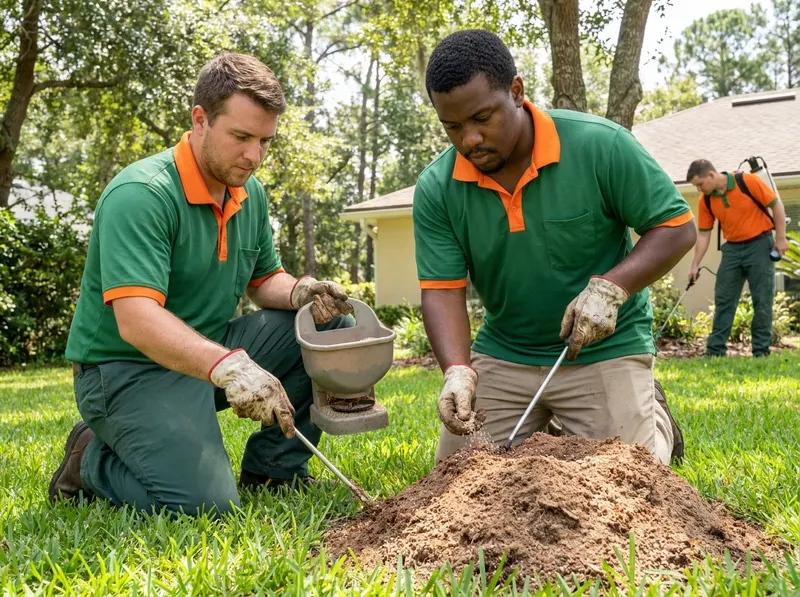
Managing biting red imported fire ants across Northeast Florida requires an understanding of regional hydrology and soil profiles. In riverfront residential communities like Mandarin, Ortega, and San Marco, high water tables and sandy loam encourage ants to construct massive, water-shedding surface mounds along driveways and lawn perimeters. Direct topical flooding with hardware-store organophosphates fails because worker ants transport queens deeper into subsurface galleries, spreading single colonies into multi-queen satellite networks. TerraGuard Insect Services approaches management through biological interruption, applying targeted biological baits verified by the University of Florida IFAS Extension that foraging workers carry into the brood chamber to sterilize queens.
Coastal humidity and sudden summer precipitation throughout Arlington, Southside, and Oceanway necessitate rainfast treatment scheduling. Protocols strictly follow the standards of the Environmental Protection Agency to prevent active compound runoff into sensitive tributaries such as the St. Johns River. When properties in Riverside, Springfield, or Avondale feature ornamental beds, the service combines exterior perimeter applications aligned with the Florida Department of Agriculture and Consumer Services guidelines with deep subterranean delivery. Rather than broad, indiscriminate spraying, precision broadcast granular formulas certified under National Pesticide Information Center profiles disrupt the ants' lifecycle without degrading groundwater quality.
Decision factors focus on acreage, colony maturity, and surrounding habitat. A single mound drench fits isolated, new nests on small urban plots; widespread broadcast baiting fits established multi-queen infestations across expansive suburban lots near the Timucuan Ecological and Historic Preserve. The trade-off centers on suppression speed versus reproductive eradication: direct mound treatments yield immediate visible reduction within 24 hours but risk colony relocation, whereas broadcast systemic baiting requires 2 to 6 weeks to disrupt reproduction while ensuring 6 to 12 months of perimeter colony suppression. Baseline evaluations observe regional turf health supported by the Florida Wildflower Foundation and the Florida Department of Environmental Protection to preserve non-target native pollinators, beneficial predatory insects, and adjacent aquatic buffers.
Technicians systematically map the exterior perimeter, applying targeted applications along foundation expansion joints and structural edges following National Pest Management Association structural protocols. Ongoing compliance with U.S. Fish and Wildlife Service habitat directives ensures treatments near maritime hammock areas remain non-disruptive to regional fauna. Routine adjustments account for soil drainage variations tracked by the USDA Natural Resources Conservation Service, delivering lasting suppression through scientifically calibrated, season-specific barrier defense.
Every job gets a firm, written price after a free on-site visit.
Tell us about your fire ant yard management job in Jacksonville and we'll send a clear, written quote, usually the same day.
 TerraGuard Insect Services